
Search local history
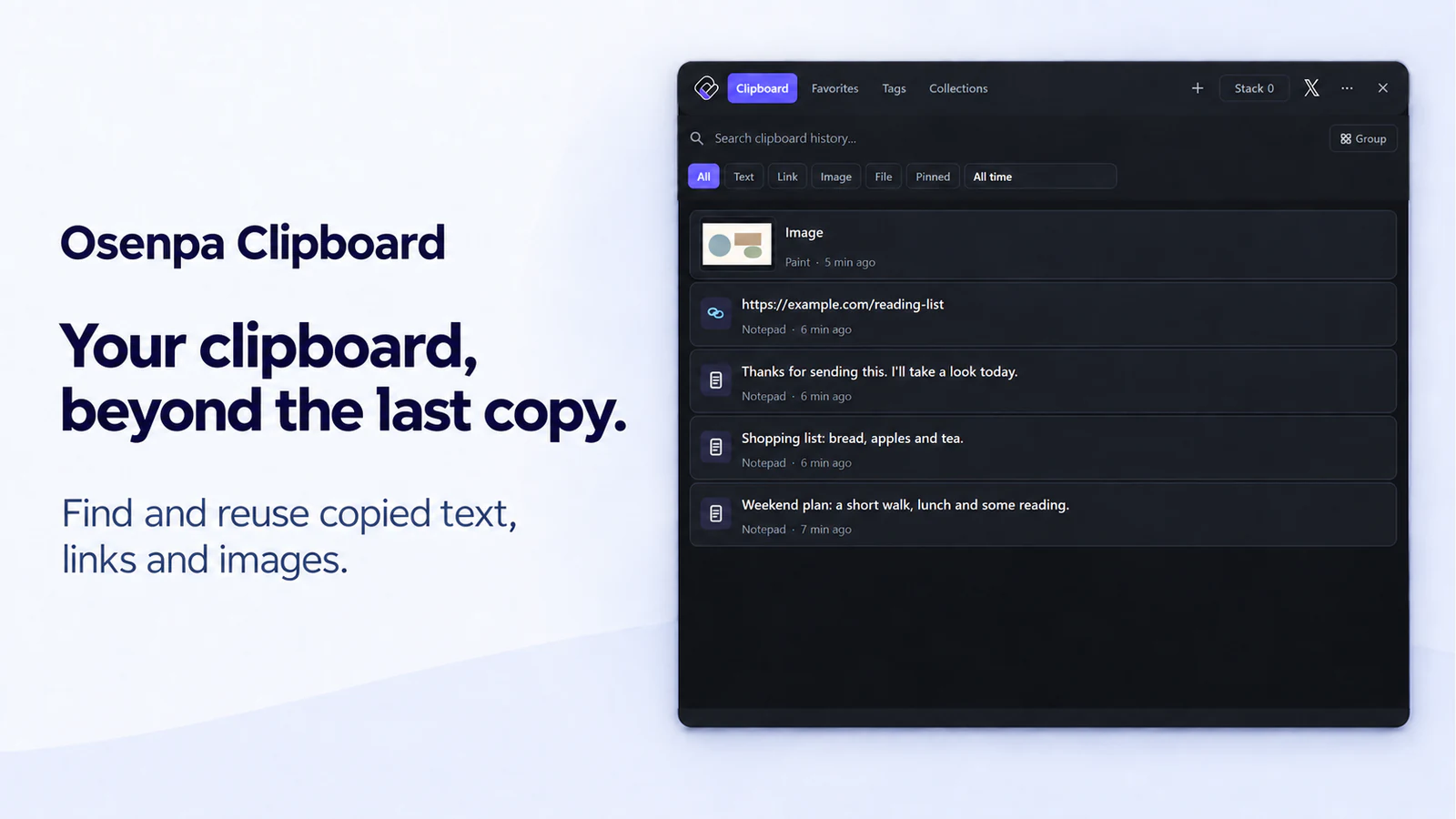
Search text, links, images, file selections and other supported items by words, exact phrases, exclusions, source application, type, domain, tag, size or date.
Find something you copied earlier and keep the clips you use most.
Free
Windows 10 2004+ or Windows 11 · x64
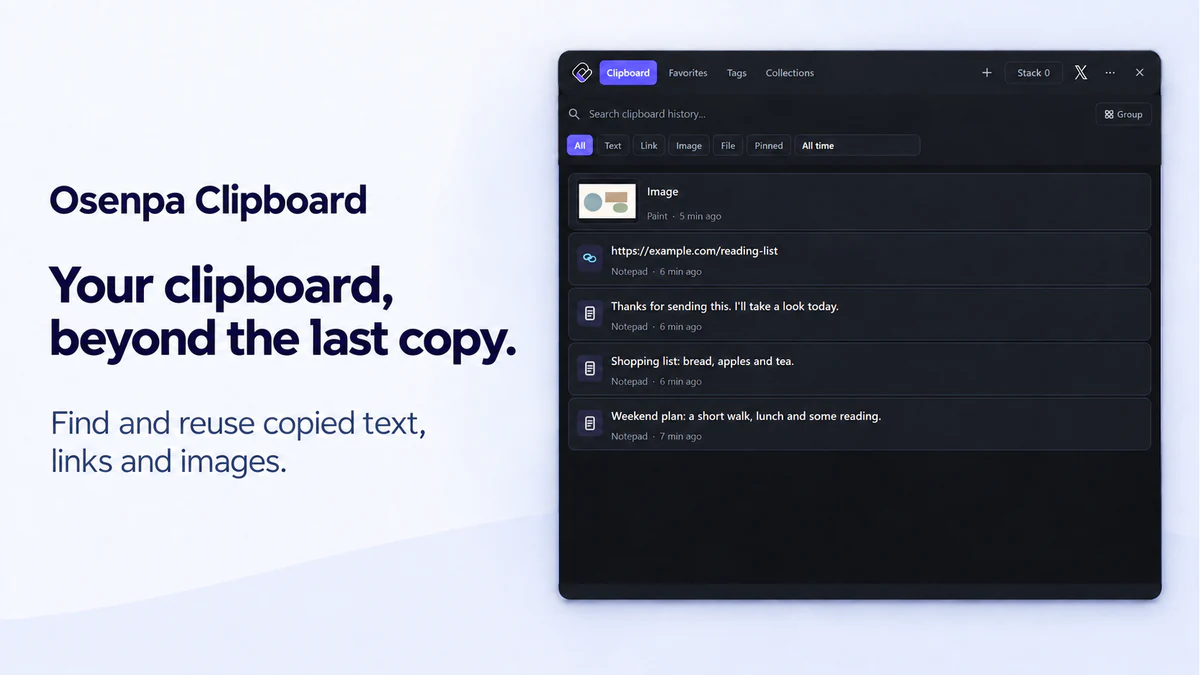
Search text, images and other supported items you copied earlier. Choose how long the app keeps them on your PC.
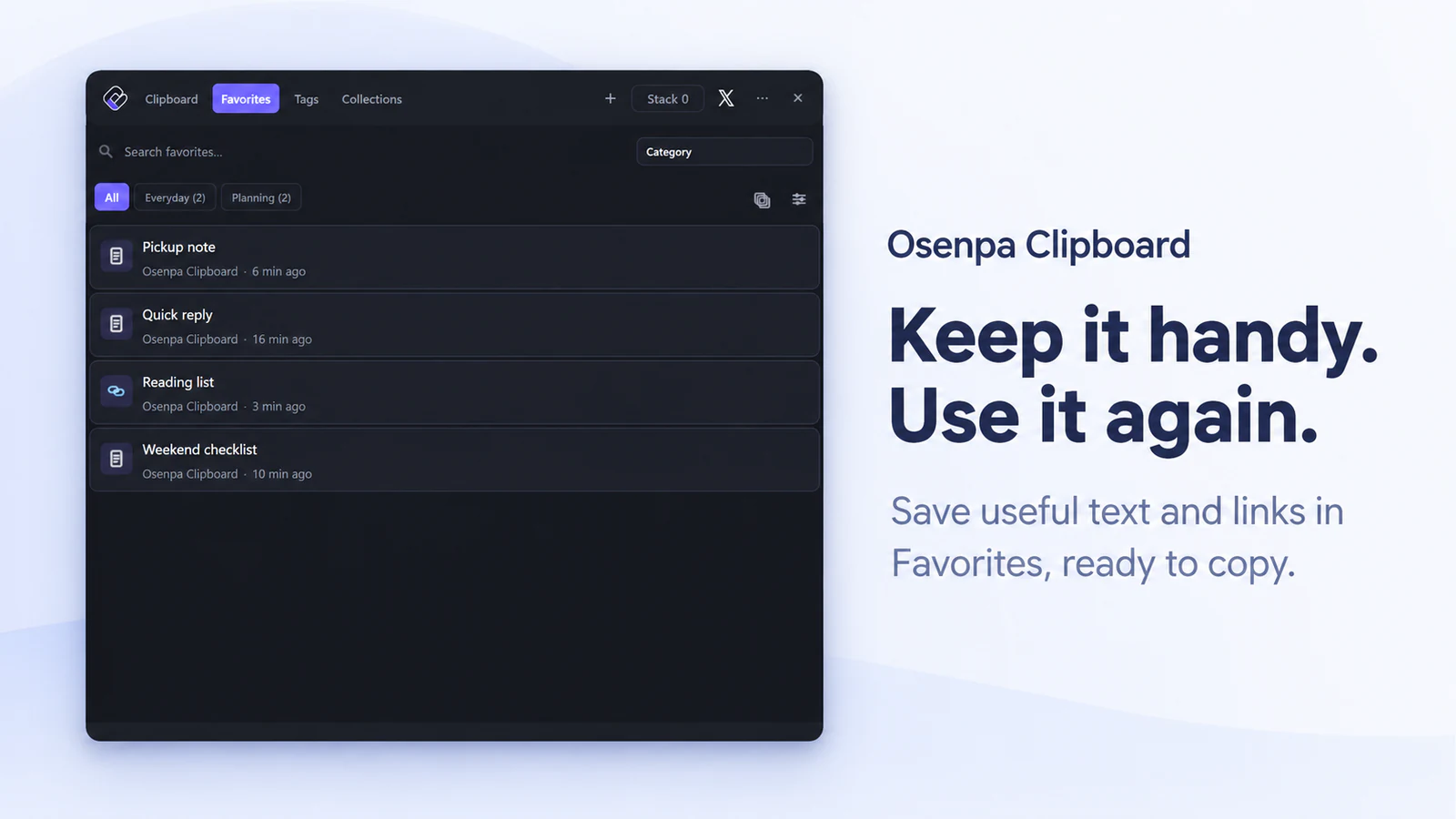
Pin or favorite items so routine cleanup does not remove material you need to keep.
Use smart collections and Clipboard Stack for repeated multi-item workflows.
Start the app on your Windows PC. Use a disposable document for this first try; ordinary history is not encrypted.
Blue kite clipboard test in the document, select it and press Ctrl+C.Blue kite. Right-click the matching card and choose Show details to check the full text and source. Choose Copy from that card's menu.If the card is missing, clear the search and type/date filters, check that monitoring is active and copy a new harmless sentence. Before copying private material, test Pause and your capture rules. For text without its original styling, use Copy as Plain Text.
Select an image for a closer look.
 Osenpa Clipboard Manager
Find something you copied earlier and keep the clips you use most.
Free
Version 2.0.2
3a589d78385b45ecda8c2c9da0511a2c4a7f73524fd709388fbb5a014aaea708 A matching checksum confirms the file matches this release record. It does not prove that software is safe or digitally signed.
Osenpa Clipboard Manager saves supported clipboard items in a local searchable history. Regular history is not encrypted, so set the retention and privacy rules before you begin. Use Pause when a copying session should not be recorded, and use Locked Notes only for selected text that needs encrypted storage.
Search text, links, images, file selections and other supported items by words, exact phrases, exclusions, source application, type, domain, tag, size or date.
Pin items, keep lasting copies in Favorites, add tags and build Smart Collections without turning every old clip into permanent clutter.
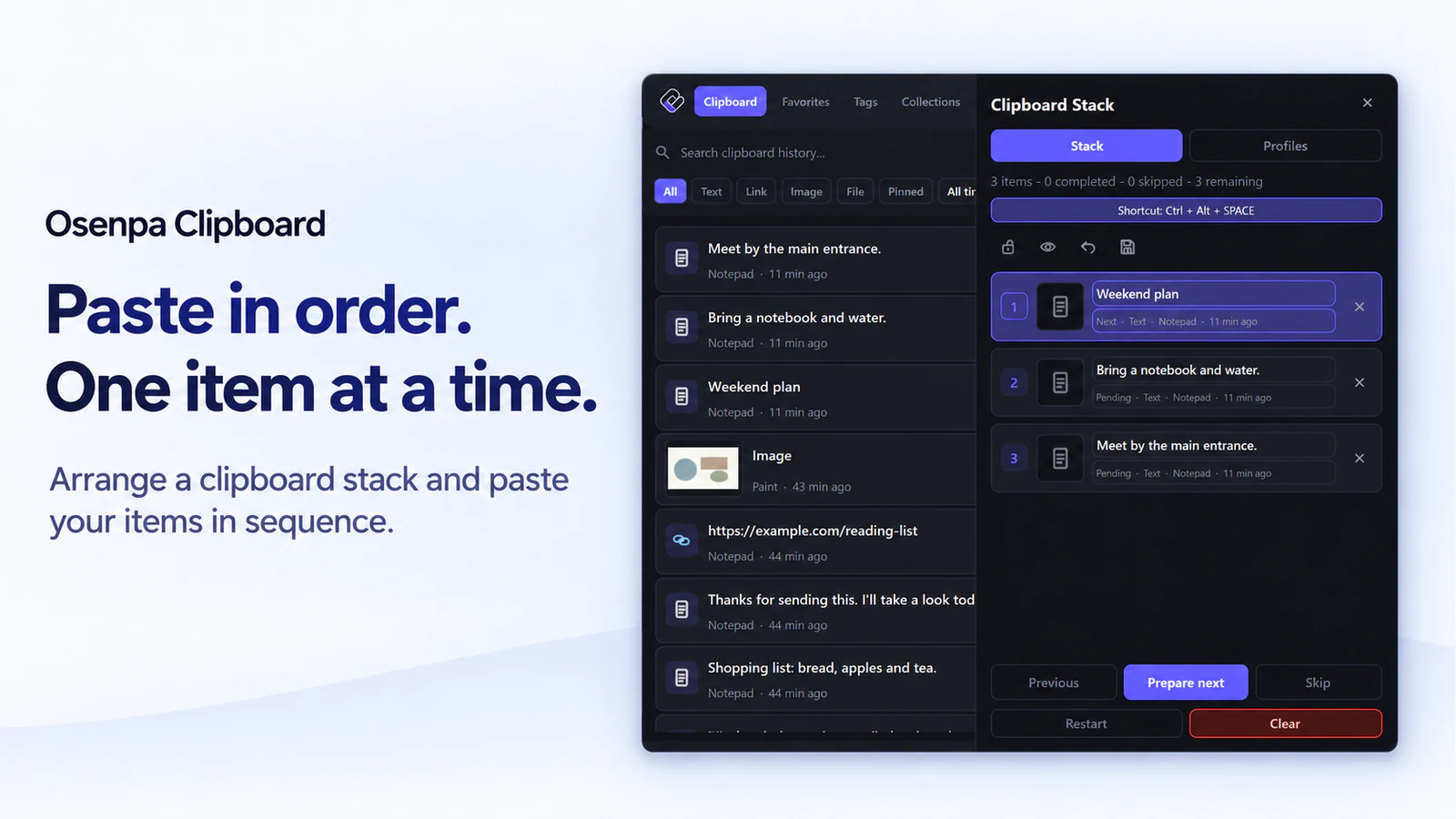
Put text, links, images and files into Clipboard Stack, arrange their order and prepare or paste each item without losing your place.
Store selected text in Locked Notes, a separate encrypted area protected by a PIN or passphrase. Regular history remains outside that area.
Choose it for your own searchable clipboard history, copied-file tracking, and repeatable paste sequences on one Windows PC.
Choose a team, cloud-sync, data loss prevention (DLP) or password-management product when policy enforcement, cross-device access or shared administration is required.
Scroll the table horizontally on a narrow screen.
| Need | Windows Win+V | Osenpa Clipboard |
|---|---|---|
| Recent clips | Built-in starting point | Stored under the configured local policy |
| Search and organization | Pinning is supported; search is not documented in the cited Windows workflow | Search, details, pins, Favorites, tags and Smart Collections |
| Paste in sequence | Manual selection | Clipboard Stack and reusable Stack Profiles |
| Encrypted storage | Not described as a separate notes area in the linked Microsoft guide | Locked Notes only |
| Cloud, team or DLP controls | Depends on separate Windows services and policy | Not provided by Osenpa |
A quieter, more stable clipboard workspace, with refinements to history, Favorites and other panels.
Choose how long regular clips should remain and how many unpinned history items are useful. The time rule can be disabled, and both controls can be changed later.
Test application exclusions, private-window detection, built-in sensitive patterns or a custom regular expression with harmless sample text. Use Pause for copying sessions that should not enter history at all.
Pin short-lived important items, save lasting copies in Favorites, add tags or Smart Collections, and place a known sequence in Clipboard Stack.
See the portfolio-level explanation in Network & data.
Windows 10 version 2004 (build 19041) or later, or Windows 11; x64 architecture
No. Regular clipboard history is stored in a local SQLite database and is not encrypted. Locked Notes is the separate encrypted area.
By default, regular unpinned history is removed after 24 hours or when the list reaches 1,000 items. In Settings, you can turn time-based deletion off or choose 1 to 360 hours, and set the cap anywhere from 100 to 100,000. Pins and Favorites are excluded from routine cleanup, so the total stored count can be higher than the history cap.
Non-file content larger than 15 MiB is not retained. File snapshots use a separate setting with Off, 10, 25, 70 and 150 MiB choices; 70 MiB is the default.
No. The encrypted Locked Notes PIN cannot be recovered if it is forgotten.
No. The app does not provide cloud sync, cross-device history or team sharing.
Privacy filters can exclude selected applications, skip a private browser window when its title can be detected, match built-in sensitive-text patterns or apply a custom regular expression. Filters are off by default. Pause is the safer choice for a whole session that should not be recorded.
A saved path reference can break when the source is moved or deleted. A file snapshot remains available only if it was created and still exists on local storage.
Prepare Next puts the current item on the Windows clipboard and advances the queue when preparation succeeds. You still need to paste it. The optional direct-paste hotkey also sends Ctrl+V to the foreground application. A reported preparation or input-delivery failure keeps the item current. Check the receiving app: delivered Ctrl+V does not prove it accepted the content.
No. The current Stack session is restored when the app opens again. A Stack Profile creates a named reusable copy and can replace or append to the current queue when loaded.
Automatic backup stays off until you choose a folder. You can set an interval from 1 to 168 hours and retain 1 to 30 backup copies. Locked Notes remains encrypted in a backup, and a restore is checked before it replaces current data.